
I’m sure that most of you know that I’m a New Yorker. I’m a native of rural central New York, and a 45-year resident of New York’s capital, Albany. The seat of state government, this small city sits 150 miles north of New York City.
Because it is the capital, Albany is filled with buildings housing state agencies and their thousands of employees. On 9/11/2001, I was a senior manager in the New York State Comptroller’s Office, which had staff in Albany and in many other parts of the state. Since New York City contains half of the state’s population, almost every state agency has staff in and around the City. Many state agencies had offices in one of the two towers of the World Trade Center. I traveled there many times for meetings, and as a tourist, brought my young family to its observation deck overlooking Manhattan.
Like most of you, I know exactly where I was when the first plane hit the towers—at a training class, a quarter mile away from my office. Within an hour of the second strike, we were told to go home, since our agency building was one of the tallest in Albany, and no one was sure whether we would be the next target.
I found my husband, and we gathered our kids from school, took them home and piled onto our bed to watch the television coverage of the unfolding disaster. We couldn’t stop watching, mesmerized by the unbelievable devastation.
Of course, my personal 9/11 experience pales in comparison to the losses felt by the families of the thousands of people who lost their lives that day, and the thousands who have died since from illnesses caused by breathing the toxic dust.
My agency lost staff that day. Dozens of other state agencies lost personnel. For months, state and local first responders and other trained personnel from all over the eastern seaboard made their way to Ground Zero to help search for remains—to try to help however they could. Everyone had a 9/11 story of friends, family and neighbors who lost their loved ones, half of whom have never been found. Whole communities were in collective grief over the loss of life. State agencies went into crisis management mode, first helping employees cope with their grief, and then developing plans to ensure that agency leadership could reach every employee in an emergency and give them clear guidance.
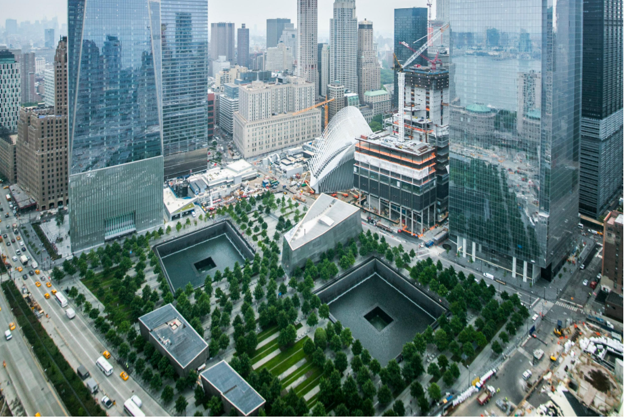
I visited Ground Zero a few years later while the cleanup was ongoing to witness, first-hand, the extent of the destruction. My husband and I visited the 9/11 Memorial and bowed our heads at the side of the deep marble fountains created in the footprint of the towers, with the names of all 9/11 victims etched on their edges. I’ve cried this morning at the first-person stories of surviving the collapse of the towers, and the stories of the family members left behind. The memories of events that day and its aftermath are still profoundly moving, even 25 years later.
So, I take this 25th anniversary very seriously. September 11th should always be a day of mourning, reverence and remembrance. It’s a day to remember that terrorists tried to destroy the fabric of American life and failed. It’s a day to remember that a small group of Al-Queda terrorists was responsible for the attack and NOT Muslim American citizens. It’s a day to remember that immigrants are not the enemy in this country. It’s a day to remember that we can work together to strengthen our own communities.
It’s a day to remember that we are all Americans, and underneath all the anger and noise and downright stupidity of today’s politics, we can find ways to work together to achieve our common goals. The President and his minions keep trying to divide us. We need to remember 9/11 and keep trying to find our way back to community.
Nancy Burton